

Travel Snacks: What really belongs in your bag (and why rest stops don't deserve your wallet)
Abstract
TL;DR – In 30 Seconds
- Rest stop snacks cost on average 3.5× more than supermarket products — often with 40% more salt and poorer ingredient quality.
- The biggest snack trap while traveling: Stress, hunger, bad options. If you're not prepared, you'll buy whatever is available.
- What really belongs in your bag: Snacks with protein, fiber, and a short ingredient list. No refrigeration needed. Crash-proof. Stable in heat.
- Practical: 10 minutes of preparation save you from 30 euros of rest stop frustration and a sugar-fueled energy slump 200 kilometers down the road.
Traveling is different. But your body isn't.
You know how it is: car, train, plane. 6 hours on the go. Eventually, hunger strikes. You look around. What do you find?
- Service station: chips, chocolate, burgers, fries
- Train station: pretzels, sweets, "energy" bars
- Airport: €8 for a sandwich with plastic cheese
- Petrol station: sausage rolls, chocolate bars, energy drinks
What they all have in common: high prices, poor ingredients, quick crash 30 minutes later.
The problem with travel isn't that you're hungry. The problem is that the options are bad if you're unprepared.
What this means for you: Travel snacks are not a diet question. They are a preparation question. Anyone who invests 10 minutes before a trip will eat more relaxed throughout the journey — and maintain energy instead of chasing it.
What travel snacks really need to be able to do
A good travel snack meets five criteria that distinguish it from a normal snack:
1. No refrigeration needed. There's no fridge in the car, train, or plane. Yogurt, cream cheese, sausage — all out. What remains: dry, crunchy, robust.
2. Leak-proof and stable. A crushed apple in your backpack is just as annoying as leaked sauce. Travel snacks need a solid shape and tight packaging.
3. Filling, but light. You don't want a heavy meal in your stomach. You want energy that lasts — without sluggishness.
4. Crash-proof. High sugar while traveling = an energy roller coaster. Exactly what you don't want on a long journey.
5. Clearly legible ingredient list. If you're already stressed while traveling, you don't want to have to guess what you're eating. Clear ingredients, clear mind.
The 8 best snacks for every trip
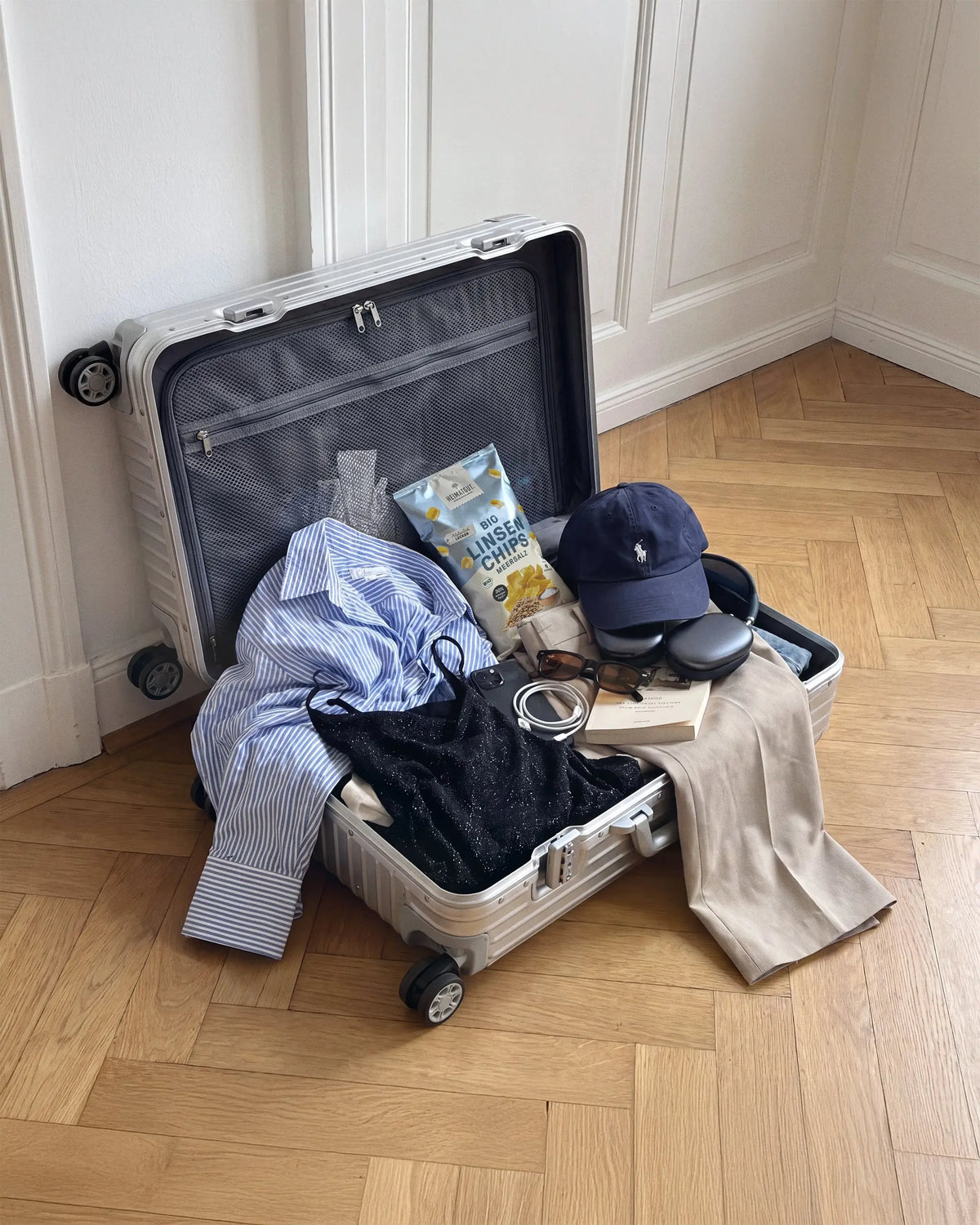
1. Organic Lentil Chips
Why they're great for travel: 10g protein and 3.9g fiber per 100g. Stabilize energy for hours. Crunchy without breaking. Perfect for: Road trips, train journeys, airport layovers.
2. Organic Popcorn
Why it works: Very light, very voluminous — the bag feels like a lot, but is calorically moderate. Wholegrain, fills you up due to its volume. Perfect for: Long train journeys, movies on the bus, breaks with children.
3. Organic Protein Chips
Why they make sense for travel: 26g protein per 100g. A 63g bag gives you ~16g protein — almost a small meal, without the meal-like heaviness. Perfect for: Hiking tours, sports trips, long flights without decent food.
4. A mix of nuts and dried fruits (trail mix)
Why: Classic — protein and healthy fats from nuts, quick energy from dried fruit. Perfect for: Hiking, outdoor activities, mountain tours. Tip: Portion your own mix into small bags — unsweetened, no chocolate trail mix.
5. Hard-boiled eggs (for short trips)
Why: 6g protein per egg, very filling, robust. Perfect for: 2-4 hour journeys in cool weather or with a cooler bag. Caution: Avoid in heat or on long flights.
6. Wholegrain rice crackers or crispbread
Why: Complex carbohydrates, stable energy, lasts forever. Perfect for: When you need something bread-like that won't get soft or crumble.
7. Apple or orange
Why: Natural sweetness, plenty of water, fiber. Robust enough for travel. Perfect for: Freshness in your bag when everything else is dry. Tip: Combine with small almond butter sachets — the perfect three-pillar combo.
8. Edamame snacks or roasted chickpeas
Why: Legume protein, crunchy, savory. Perfect for: When you want something salty that won't cause a crash.
The snack strategy by type of travel
Road trip (4–10 hours car)
You need: volume, crunch, easy to eat by hand. Optimal: Lentil chips, organic popcorn, nuts, an apple. Don't forget water.
Train journey (2–6 hours)
You need: odorless snacks that won't bother fellow travelers. Optimal: Protein chips, popcorn, trail mix, hard-boiled eggs (if not traveling for too long).
Flight (3+ hours)
You need: snacks that can withstand security checks and cabin pressure. Optimal: Lentil chips, organic popcorn, trail mix. Saltiness is okay here — high altitude air dehydrates, salt helps with fluid balance.
Hiking tour / Outdoor
You need: high energy density, protein for muscle recovery, compact. Optimal: Nuts, trail mix, dark chocolate (70%+), protein chips, dried lentil chips.
Family trip with children
You need: snacks everyone likes, clean, low packaging waste. Optimal: Organic popcorn (a classic), rice crackers, apple slices, small bags of Heimatgut snacks for their hands.
The 10-minute preparation
Sounds simple, but it's the crucial lever. If you invest 10 minutes before your trip, you'll save €30 on overpriced petrol station snacks and an afternoon full of energy dips.
Step 1: Create a travel snack bag. A small cloth bag or box in the car/backpack. Three to five clean snack options.
Step 2: Fill a water bottle. Sounds trivial — but it's the main reason many people feel hungry while traveling when they're actually thirsty. A reusable bottle saves money and plastic.
Step 3: A "backup combo" for unexpected hunger. If hunger becomes greater than planned: a bag of protein chips + an apple = mini-meal. This prevents emergency fries at the service station.
Step 4: Plan two snack slots per travel day. Morning and afternoon. This keeps your blood sugar stable instead of letting hunger waves drive you.
What Heimatgut offers for travel
Our snacks are practically made for on-the-go. Not because we planned it that way — but because they meet all five travel criteria:
- No refrigeration needed ✓
- Stable packaging ✓
- Filling without heaviness ✓
- Crash-proof (low GI, high protein/fiber content) ✓
- Clean ingredient list (organic, short lists, no industrial additives) ✓
Especially practical for travel:
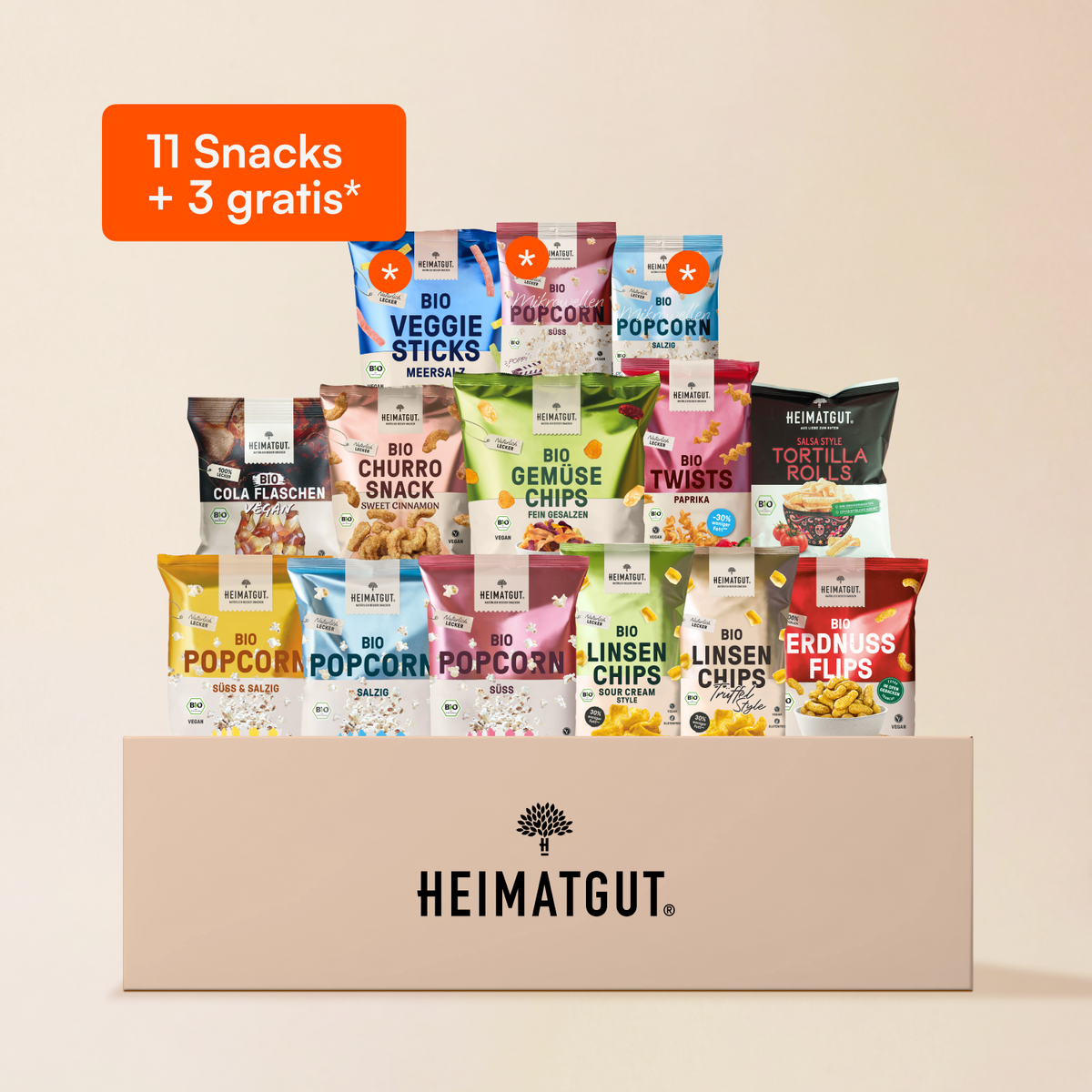
- Organic Protein Chips Multipack — small bags, perfectly portioned
- Organic Lentil Chips Multipack — various flavors, hand-sized
- Organic Popcorn Multipack — light, voluminous, ideal for the car or bus
- Heimatgut Boxes — if you want to buy structured stock for a vacation
→ Heimatgut Snacks for On-the-Go
If you want to understand the logic behind satisfying snacks even deeper: Here we explain the three-pillar formula for good snacks →
Three takeaways
- Travel snacks are not a diet question, but a preparation question. Those who are prepared eat more relaxed and better while traveling.
- Service stations don't deserve your wallet. 3.5x more expensive, poorer ingredients, guaranteed energy crash.
- 10 minutes of preparation = relaxed trip. Snack bag, water, backup combo. That's all it takes.
You don't have to starve while traveling. You just have to pack smarter.
→ Discover Heimatgut Snacks — perfect for on the go
FAQ
What are the best snacks for the car? Crunchy, dry snacks without refrigeration needs — Lentil Chips, Organic Popcorn, Protein Chips, trail mix. Plus always a water bottle. Important: snacks that don't crumble or get greasy on your hands.
What snacks can you take in hand luggage? Dry snacks are unproblematic — chips, popcorn, nuts, bars, crackers. Creamy or liquid products over 100 ml are forbidden. Fresh fruit only on intra-European flights, usually not on intercontinental flights.
What's best to eat on a hiking tour? Compact, energy-dense snacks: nuts, trail mix, dark chocolate (70%+), protein chips, lentil chips. Plus enough water and something salty for electrolyte balance.
Are organic snacks sensible for on the go? Definitely. Travel stress weakens the immune system anyway — clean ingredients without pesticide residues and industrial additives relieve the body. Furthermore: short ingredient lists = better planning for allergies or intolerances.
How do I prevent cravings on long journeys? Three rules: 1) Snack regularly (a small snack every 2–3 hours), 2) Protein + fiber instead of sweets, 3) Drink enough — often "hunger" is actually thirst.
What's the best snack strategy for families? A small snack box for each child with 2–3 options — gives autonomy, avoids "Mom, I'm hungry" escalations. Organic popcorn, rice crackers, apple slices, a small bag of salty snacks.
Which snacks hold up well in the heat? Dry, low-fat snacks: rice crackers, popcorn, lentil chips, dried legumes. Chocolate and anything with a lot of fat can melt or go rancid in the heat — so it's better to transport them in an air-conditioned area or compact containers.
Sources:
- Federal Centre for Nutrition (BZfE) – "Snacks for on the go"
- ADAC – Travel provisions & service station price comparison 2025
- DGE – Recommendations for snacks
- Augustin et al. (2015) – Nutrition, Metabolism and Cardiovascular Diseases, "Glycemic index and travel snacks"
- Njike et al. (2016) – Advances in Nutrition, "Snack Food, Satiety, and Weight"
- TÜV Süd – Food hygiene at travel temperatures