

Snacks that taste good – and are still good for you: Why "conscious eating" doesn't mean renouncing anything

Abstract
TL;DR – In 30 Seconds
- 67% of people give up on "mindful eating" – not due to lack of discipline, but because it becomes bland.
- "Healthy" and "tasty" have been portrayed as opposites for decades. This was an industry marketing strategy – not the truth.
- Real, honest ingredients taste more intense than their industrial counterparts. An organic potato has more flavor than a conventionally grown french fry.
- The trick is not "eat less," but "eat better." Mindful snacking means focusing on enjoyment – not deprivation.
We've had to make choices for too long
Imagine decades of food marketing. What you were constantly told:
- Delicious = unhealthy
- Healthy = bland
- Indulgence = guilt
- Sin = reward
This is a story the industry sold us. They benefited from it — convenience products sell better when "diet products" are placed next to them. The whole system thrived on opposition.
But is this opposition even true?
67% of people give up "healthy eating" — according to a 2025 Mintel survey, not due to lack of discipline, but because it's perceived as bland. If "healthy" is uninteresting in taste, no one sticks with it.
But that's not due to "healthy." It's due to what we've been conditioned to think of as "healthy": low-fat yogurts with sweeteners. Dry rice crackers. Salad leaves without dressing.
What this means for you: The question isn't whether you can "eat mindfully" without deprivation. The question is whether you understand that the industry sold you false options.
What really happens when you switch to real ingredients
Here's the effect most people underestimate: Real ingredients taste more intense than their industrial counterparts.
Example 1: Organic corn vs. conventional corn
Organic corn is grown more slowly, gets more sun, and develops more flavor. Organic popcorn made from organic corn has a fuller corn flavor than the conventional variety — and you can taste it.
Example 2: Real spices vs. flavorings
"Sour Cream Flavor" is created in a lab — an approximation of the taste of sour cream. Real sour cream seasonings (yogurt powder, onion, parsley) have multiple flavor dimensions. More complex, more satisfying, longer-lasting.
Example 3: Pea protein vs. whey
Pea protein comes from a whole plant — bringing its own slight sweetness, a natural nuttiness, a full mouthfeel. Whey is isolated protein that is virtually tasteless without sweeteners and flavorings.
Example 4: Organic sunflower oil vs. refined industrial oil
Organic oil retains more natural flavor notes. Industrial oil is refined and stripped — neutral, but empty.
What this means for you: If "mindful eating" has seemed bland to you so far, it was probably not because of the food itself — but because of industrially stripped foods with a "healthy" sticker. Real ingredients taste like more because they are more.
Three myths we should finally get rid of
Myth 1: "Healthy snacking is less fun."
False. A bag of organic popcorn doesn't taste less than a bag of industrial chips — it tastes different. Fuller-bodied, less salty-flat, more "real corn" flavor. Once you've made the switch, you rarely want to go back.
Myth 2: "Mindful eating is complicated."
False. It's actually simpler. Instead of studying 15 ingredients, you check a short list for readability. Instead of choosing between "Light," "Zero," "Diet," and "Original," you choose the product with honest ingredients.
Myth 3: "Healthy is about deprivation."
This is where it gets interesting. Deprivation is a matter of mindset. Someone who sees "chocolate" as a reward perceives organic popcorn as deprivation. Someone who sees organic popcorn as an indulgence perceives industrial chips as a compromise. Taste geography is shifting.
This happens surprisingly quickly. Studies show: After about 3–4 weeks with fewer sweeteners and industrial flavors, the sense of taste noticeably changes. What tasted bland before now tastes full-bodied. What tasted perfectly sweet before now tastes artificial.
What mindful snacking means in practice
It's not about changing everything. It's about replacing the snacks you already eat with better versions.
Step 1: One snack category at a time
Not everything at once. For one week: only popcorn instead of chips. A week later: only protein chips instead of muesli bars. Gradually switch, instead of radically changing.
Step 2: Pay attention to taste
Really taste while eating. Don't just mindlessly eat the whole bag while watching Netflix. Chew consciously, consciously register what you're eating. This makes the enjoyment more intense — and you automatically eat less.
Step 3: Don't think in black and white
An occasional bag of industrial chips won't ruin your life. But if 80% of your snacks are organic and clean label and 20% are "unhealthier" — then you've won. Nobody has to be perfect.
Step 4: Redesign your desk / drawer
What's available gets eaten. If at 3 PM there are lentil chips in the drawer and no chocolate bars — you'll eat lentil chips.
What Heimatgut contributes to this lifestyle question
We don't see ourselves as a "diet brand" or a "health brand." We see ourselves as a snack brand that tastes good AND has honest ingredients.
The difference is important. It's not about what you can't eat. It's about what you like to eat — in a version you won't regret.
Our promises:
- Real ingredients instead of industrial flavors
- Organic certified — from cultivation to packaging
- Short ingredient lists (3–7 ingredients for most products)
- Taste first — no snack leaves our range if it doesn't truly taste good
Our range covers various snack needs:
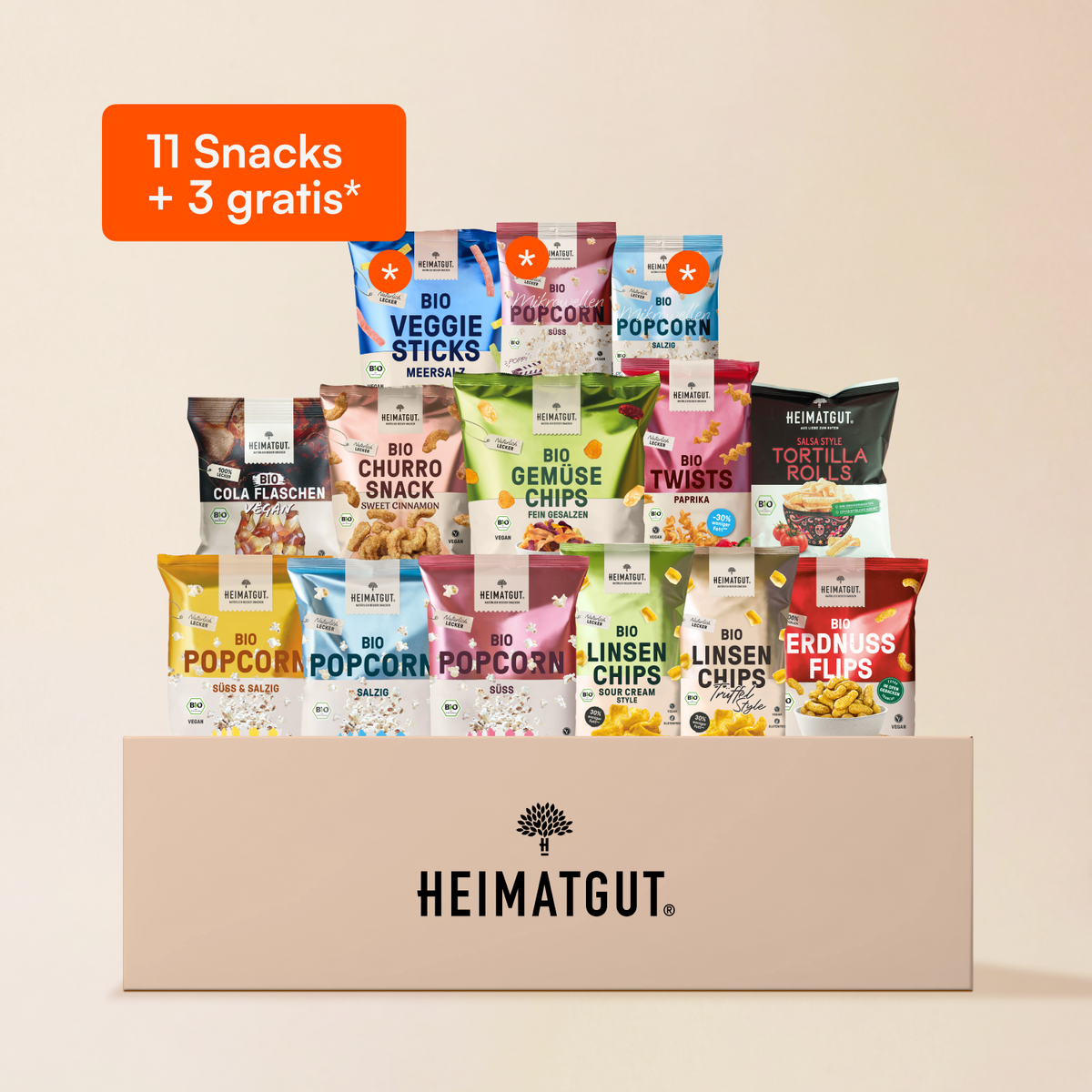
- Organic Popcorn — for sofa movie nights
- Organic Protein Chips — for afternoons at your desk
- Organic Lentil Chips — for a savory lunch break
- Organic Heartful Snacks — for on the go
You don't have to choose between "healthy" and "delicious." You just have to choose the brands that take both seriously.
→ Discover Heimatgut — Snacks without compromise
If you want to know more precisely how honest organic foods are defined: Here is our organic guide →
Three takeaways
- "Delicious" and "mindful eating" are not opposites. That was industrial marketing — not truth.
- Real ingredients taste more intense. Organic corn, real spices, honest processing — you can taste it.
- Taste is trainable. After 3–4 weeks with better snacks, you rarely want to go back.
You don't have to deprive yourself. You just have to find the better snacks — and then enjoy them.
→ Heimatgut Snacks — delicious, honest, organic
FAQ
Do organic snacks really taste better than conventional ones? Often yes, because the ingredients are more intense. Organic corn has more corn flavor, real spices have more depth than flavorings. But: it's also a matter of habit. Someone who has eaten industrial snacks for years needs 2–3 weeks to really taste the difference.
How long does it take for my taste to adjust? Studies show: 3–4 weeks with fewer industrial flavors and sweeteners. After that, industrial sweetness often tastes artificial, and real foods become more satisfying in taste.
Do I have to completely avoid industrial snacks? No. If 80% of your snacks are honest, you've made the main gain. The 80/20 rule works better here than radical strictness — and is more sustainable.
Are organic snacks more expensive? Yes, typically 20–60% more. But: You often eat less because you snack more mindfully and feel satisfied faster. Per satisfaction, the price can end up being similar.
What do I do if my family doesn't like "healthy" snacks? Introduce them gradually, don't switch completely. Organic popcorn is usually the easiest entry point — tastes almost like familiar popcorn, but cleaner. Then slowly introduce other products. Children adapt surprisingly quickly if the taste is right.
How do I recognize if a "healthy" snack is really good? Three checks: 1) Organic seal on the packaging, 2) short ingredient list (max. 7–8 ingredients), 3) no artificial flavors, sweeteners, or flavor enhancers. If all three are true: solid choice.
Why do so many people give up "healthy eating"? Mostly not because of discipline, but because of taste and complexity. Those who impose deprivation instead of seeking enjoyment rarely stick with it for long. Those who simply choose better versions of their favorite snacks, on the other hand, make lasting changes.
Sources:
- Mintel (2025) – "Why Consumers Abandon Healthy Eating", Global Food Trends Report
- Pepino (2015) – Physiology & Behavior, "Metabolic effects of non-nutritive sweeteners"
- Drewnowski (2009) – Annual Review of Nutrition, "Taste preferences and food intake"
- DGE – Recommendations on Mindful Eating and Enjoyment
- Bundeszentrum für Ernährung – "Delicious and healthy: no contradiction"
- Hall et al. (2019) – Cell Metabolism, Ultra-Processed Foods and Taste Perception