

Fiber-Maxxing: Why Everyone Will Be Talking About Fiber in 2026 — And What Most People Are Getting Wrong
Suddenly everyone is talking about fiber
Two years ago, "fiber" was a word for nutritionists and people over 70.
Today? It's one of the biggest food trends of the year.
On TikTok, wellness influencers are showcasing bowls full of chia seeds and oatmeal. Prunes — dried plums, the epitome of grandparent nutrition — have seen a 60% increase in UK supermarkets. PepsiCo is building entire product lines around them. Whole Foods declared fiber a top trend for 2026.
The term for this: "Fiber-Maxxing." The principle: as much fiber as possible, every day.
Sounds good at first. Finally, people are focusing on something that really matters. But like any hype, there's a catch — and the TikTok version keeps it quiet.
Why the trend is right (for the most part)
Let's start with what's true. Because the core of the trend is scientifically sound.
Fiber intake is indeed insufficient
In Germany, about 75% of women and 68% of men do not meet the DGE recommendation of 30g of fiber per day. The average is 18-19g. That's a real gap — not an invented one.
The effect is well-documented
Fiber feeds your microbiome. Fermentation produces butyrate — a short-chain fatty acid that provides about 70% of the energy for your gut cells, reduces inflammation, and strengthens the gut barrier. A DGE meta-analysis shows: More fiber = lower mortality risk.
The trend draws attention to a real problem
PepsiCo CEO Ramon Laguarta literally said in October 2025:
"I think fiber is going to be the next protein. Consumers are starting to understand that fiber is the benefit they need."
What this means for you: If you start paying attention to fiber because of the trend — good. The initial impulse is correct. Most people really do eat too little.
Where the trend falters: The Maxxing error
Now for the catch. And it's an important one.
"Maxxing" means: If something is good, more of it is better. With fiber, that's not true.
Too much, too fast = problem
The Academy of Nutrition and Dietetics is clear: Anyone who increases their fiber intake by more than 5g per day at once risks bloating, cramps, and digestive stress. The gut needs weeks to adapt.
So, if you suddenly shovel in 50g of fiber after a TikTok video, you'll feel worse, not better — and give up frustrated.
Very high amounts can block minerals
Health experts point out: Extremely high amounts of fiber can impair the absorption of minerals like iron and zinc — especially relevant for people who are already borderline.
Industry is hijacking the trend
Here's where it gets tricky. Because "high fiber" now sells, enriched products are suddenly everywhere — even sugary cereals are touting fiber. But isolated fiber in an otherwise highly processed product is not the same as fiber from real food.
What this means for you: The mistake isn't paying attention to fiber. The mistake is seeing it as a pure quantity game — and falling for enriched industrial products.
What really matters: Diversity beats maximization
Here's the most important insight — and it doesn't come from TikTok, but from Mintel, one of the leading market research institutes.
Mintel's forecast for 2026:
The focus is shifting from maximization to balance. Consumers are moving away from rigid nutritional goals towards more diverse, balanced diets.
Translated: It's not about eating as much fiber as possible. It's about regularly eating different types of fiber.
Why? Because your microbiome is not a monolith. Different gut bacteria need different types of fiber:
- Soluble fiber (oats, legumes, apples) — forms a gel, good for cholesterol and blood sugar
- Insoluble fiber (whole grains, vegetable peels, nuts) — aids digestion
- Resistant starch (cooled potatoes, legumes, corn) — particularly good food for butyrate producers
A Japanese double-blind, randomized study showed that just four weeks of additional, diverse fiber measurably changed gut flora and improved how healthy adults felt.
What this means for you: You don't need a fiber competition. You need various real foods — regularly, not maximally. Diversity + consistency beats any 50g record day.
The honest trend classification
Lest this sound like riding a trend — the sober truth:
Fiber-Maxxing as a TikTok phenomenon will fade. Like any hype. What won't fade is the underlying realization: Most people eat too little and too one-sidedly with regard to fiber.
So the trend is a good occasion — but a poor guide. Follow the impulse (more fiber), ignore the exaggeration (as much as possible, preferably as powder).
What Heimatgut specifically offers here
We're not riding the fiber trend — we were already there before it was a trend.
Instead of pouring isolated fiber into a product just to label it "high fiber," our snacks deliver fiber as nature intended: in real food, with different types of fiber.
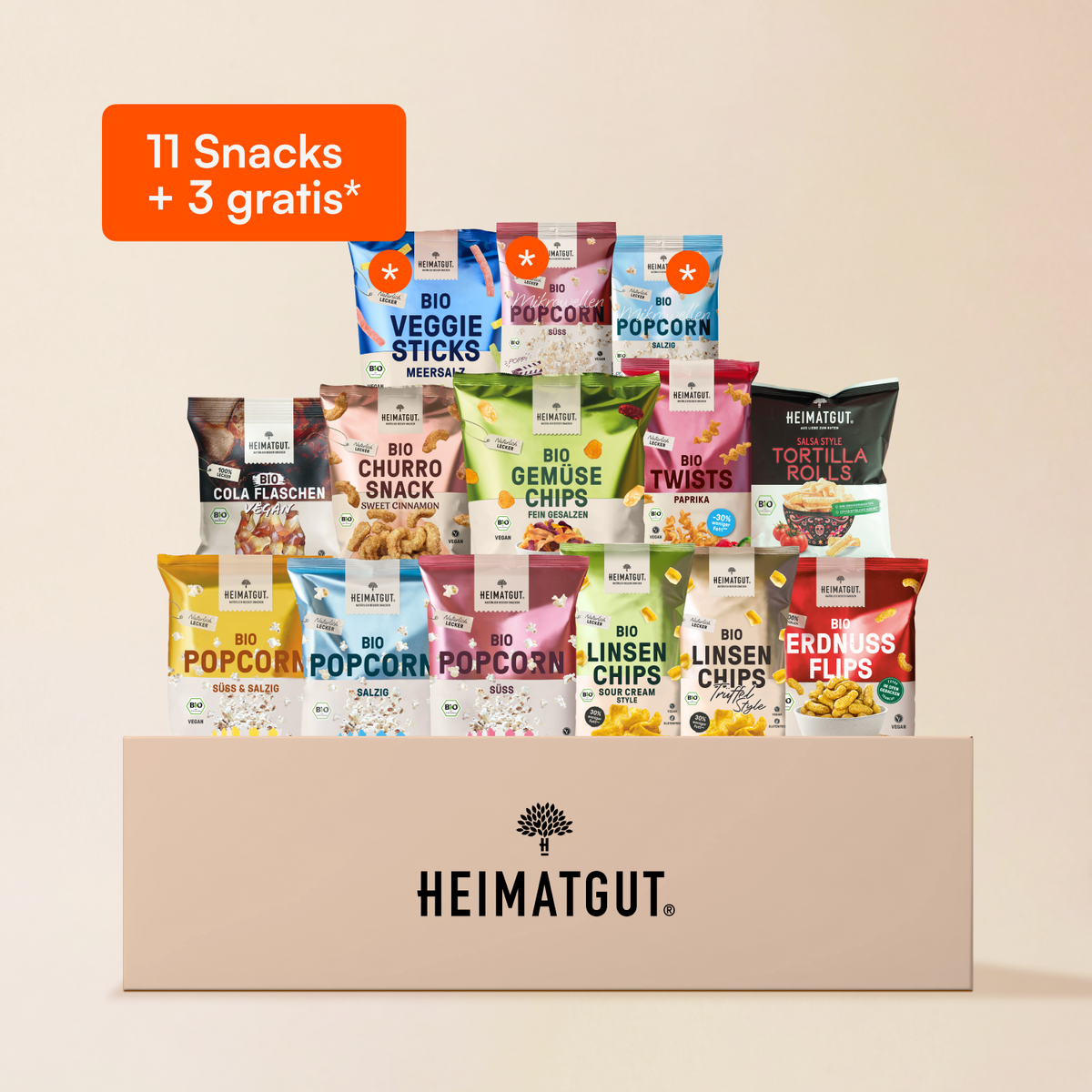
- Organic Popcorn: 100% whole grain, 10g fiber / 100g — insoluble fiber from the whole corn kernel
- Organic Lentil Chips: Legume-based — soluble fiber plus protein
- Organic Nuts: Fiber plus healthy fats plus micronutrients
And for those who want to systematically try different fiber sources, there's the Heimatgut Fiber Box: Four varieties, four different fiber profiles, 100% organic, no sugar, no additives. Exactly what the diversity-over-maxxing logic recommends.
→ To the Heimatgut Fiber Box → More on our Fiber Mission
If you want to understand the mechanisms behind fiber and the microbiome in more detail: Here we explain butyrate & gut health in detail →
Three takeaways
- The trend is fundamentally right: You probably eat too little fiber.
- But Maxxing is the wrong approach: Too much too fast harms. Diversity beats quantity.
- Real food beats powder: Various fibers from real foods, regularly — not maximally.
You don't have to set a record. You just need to snack more diversely and consistently.
FAQ
What is Fiber-Maxxing? A social media trend (especially TikTok) where people eat as much fiber as possible per day to maximize gut health and satiety. The basic impulse is correct, but the "more is better" logic is problematic.
How much fiber should I really eat? The DGE recommends at least 30g per day. More important than the exact maximum is: diverse sources and slow increase. More than 5g extra per day at once can lead to digestive stress.
Is too much fiber harmful? Very high amounts, especially with a sudden increase, can cause bloating, cramps, and in extreme cases, reduced mineral absorption. Increase slowly, drink plenty of water, and eat a varied diet.
Are fiber powders a good solution? They can temporarily fill the gap, but they don't replace a varied diet. Real foods provide various types of fiber plus vitamins, minerals, and phytochemicals.
Why is fiber diversity more important than quantity? Different gut bacteria need different types of fiber (soluble, insoluble, resistant starch). A single source in large quantities only feeds part of the microbiome. Diversity supports a more diverse, robust microbiome.
Are Heimatgut snacks part of the fiber trend? We are not riding the trend — our products deliver fiber from real ingredients (whole grain corn, legumes, nuts), not from isolated additives. This is exactly what the diversity-over-maxxing research recommends.
Sources:
- Mintel (2025) – Global Food & Drink Trends 2026, "Fiber diversity over maxxing"
- Johns Hopkins Center for a Livable Future (2026) – "Food Trends 2026: Focus on Fiber-Maxxing"
- CNBC (2025) – "Fibermaxxing: PepsiCo and food brands chase high-fiber trend"
- Academy of Nutrition and Dietetics – Recommendations for Fiber Increase
- ScienceAlert (2026) – "The New Gut Health Obsession Comes With a Catch"
- Deutsche Gesellschaft für Ernährung (DGE) – Fiber Reference Values 2022
- GlobalData / Ocado (2025) – Gen Z Fiber Consumption Survey