

What does organic really mean for snacks? What matters — and what doesn't
Abstract
TL;DR – In 30 Seconds
- The EU organic label is a clearly defined, legally regulated standard — no synthetic pesticides, no genetic engineering, at least 95% organic ingredients.
- 58% of Germans mistakenly believe: "Natural" is the same as "organic." It is not.
- For snacks, it's not just the label that matters, but the ingredient list: An organic muesli bar with 18 industrial ingredients is still a highly processed product.
- The honest combination: EU organic label + short, clean ingredient list. This is the formula for truly honest snacks.
"Organic" is everywhere — but what's really behind it?
You walk through the supermarket. "Organic" is on many packages. You see:
- "Organic cookies"
- "Naturally good"
- "From controlled cultivation"
- "With natural ingredients"
- "Farm tradition"
Are they all organic? No. Not even close.
A survey by the Federal Ministry of Food and Agriculture shows: 58% of German consumers mistakenly believe "natural" is the same as "organic."
It's not their fault. Over the years, the industry has built an entire language that sounds organic without actually being organic. If you really want to understand what you're buying, you need to know where the real difference lies.
The good news: There are only two things you really need to know.
The EU organic label: What it really guarantees
The green leaf EU organic logo is the legally protected organic certification of the European Union. Anyone who carries it must meet strict requirements.
Specifically, this means:
- No synthetic pesticides
- No chemical-synthetic fertilizers
- No genetic engineering (neither in ingredients nor in feed)
- At least 95% of ingredients must come from certified organic farming
- Strict controls by independent certification bodies, at least once a year
- More animal-friendly husbandry for animal products
- Only about 50 of the 320 additives approved in the EU are permitted
This is not a minimum standard in the sense of "just above conventional." This is a substantial hurdle that no industrial food manufacturer meets "incidentally." Those who commit to EU organic have restructured their entire supply chain.
What this means for you: If the EU organic logo is on a package, you can be sure that it is backed by controls, clear rules, and verifiable requirements. It is a genuine guarantee — not just a marketing promise.
What organic means specifically for snacks
Snacks are a category where industrial food manufacturers pack in a lot. Let's briefly compare what is typical in conventional vs. organic snacks:
Conventional industrial chips (typical):
- Potatoes from conventional cultivation (often detectable pesticide residues)
- Sunflower oil from mass production
- Flavorings (industrially produced, often declared as "natural")
- Flavor enhancers (yeast extract, glutamate)
- Sugar or glucose-fructose syrup
- Modified starch
- Preservatives
Organic snacks according to EU organic standard (typical):
- Organic potatoes (controlled cultivation, no pesticides)
- Organic sunflower oil
- Real spices instead of flavorings
- Organic salt
- Short ingredient list (usually 3–7 ingredients)
The difference has concrete effects:
1. Fewer pesticide residues. Conventional snacks regularly show traces of several pesticides in tests. Practically undetectable in organic snacks.
2. No genetic engineering. For conventional corn or soy, genetic engineering is standard in many countries of origin. Organic guarantees freedom from genetic engineering.
3. Better soil health & climate footprint. Organic farming builds up humus instead of depleting it — a long-term climate issue as well.
4. Clearer ingredient lists. Organic regulations only permit a fraction of conventional additives. In reputable organic snacks, the ingredient list is therefore often half as long.
Where the real leverage lies: The ingredient list
Here's the point that most organic buyers overlook — and which is more important than the label itself for snacks:
An organic product with a long industrial ingredient list is still a highly processed product.
The EU organic label guarantees cultivation and origin. But it does not state how heavily processed the final product is.
Practical examples:
- Organic muesli bar with 18 ingredients (including organic glucose syrup, organic maltodextrin, organic flavorings, several organic emulsifiers) → is organic, but remains a highly processed product
- Organic frozen pizza with 25 ingredients → organic label or not, this is an industrial food product
- Organic lemonade with organic sweeteners and organic flavorings → industrial construct with an organic label
On the other hand:
- Organic popcorn with 3 ingredients (organic corn, organic sunflower oil, sea salt) → honest, minimally processed food
- Organic protein chips with 5 ingredients (pea protein, organic potato, organic rice, organic sunflower oil, sea salt) → short list, clear ingredients
What this means for you: The organic label is an important guarantee for cultivation and origin. But for snacks, the ingredient list determines whether the product is ultimately honest or highly processed. Both dimensions are important — and the second is often forgotten.
The 5 organic marketing tricks you should know
Not everything that looks organic is organic. These tricks often appear:
Trick 1: Green packaging + nature motifs
Green color, leaves, "nature" images — without it being organic. Visual "greenwashing." Check: Look for the EU organic logo. If it's not there, it's not organic.
Trick 2: "From controlled cultivation"
Sounds organic. It's not. Conventional cultivation is also "controlled" — namely by EU pesticide regulations. Check: "From controlled organic cultivation" with the word "organic" — that's organic. Without that word: conventional.
Trick 3: "Natural" or "natural flavoring"
The term "natural" is not protected. "Natural flavoring" can be completely produced in a lab as long as the raw material was natural. Check: Be suspicious of "natural" as a quality feature. Legally, it often means surprisingly little.
Trick 4: Regional ≠ Organic
Regional products can be conventional. Organic products can come from abroad. Check: Both aspects are valuable, but different. Ideally, you have both — organic standard and (where possible) regional origin.
Trick 5: "Tradition" and "Craft"
Marketing poetry. Says nothing about ingredients or cultivation. Industrial muesli bars with 15 ingredients can call themselves "traditional." Check: Tradition is in the ingredient list, not in the advertising language.
How to read an organic snack label in 30 seconds
Two steps. That's all you need.
Step 1: Label Check Is the EU organic logo (the green leaf) on it? If yes: cultivation, origin, and GMO-free status are guaranteed. That's a solid basis.
Step 2: Ingredient List Check How long is the list? Ideally 3–7 ingredients. Are all words pronounceable and recognizable? Are there flavorings, maltodextrin, sweeteners, or emulsifiers?
Both checks passed = honestly processed organic product.
What this means for you: You don't have to become a food chemist. The organic label as the entry point, a short ingredient list as confirmation. If you do that, you won't fall for marketing promises anymore.
Where Heimatgut stands
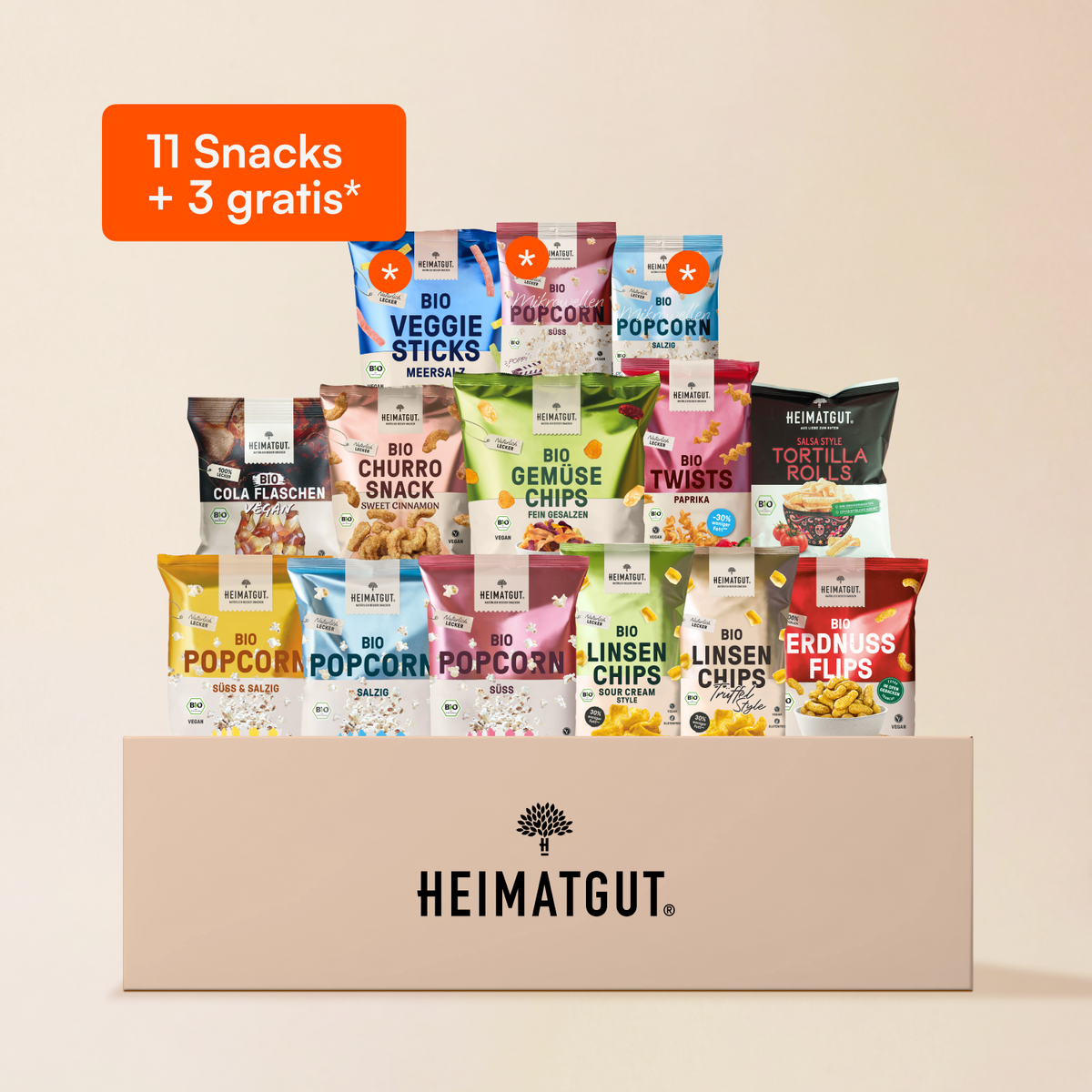
Heimatgut is 100% EU organic certified. This is not just one feature among many — it's a fundamental decision that shapes our entire supply chain.
But: We also know that the organic label alone is not enough. Just as important is what ultimately ends up in the bag. That's why we adhere to a self-imposed rule:
Short ingredient lists. Real ingredients. No industrial ballast.
What this specifically means:
- EU organic certified for all products
- 3–7 ingredients in most of our snacks
- No flavorings, no sweeteners, no flavor enhancers
- No palm oil — we use organic sunflower oil or organic coconut oil
- Baked or popped, not fried
- Real spices and salt instead of industrial seasonings
Examples from our range:
- Organic Popcorn Salty: Organic corn, organic sunflower oil, sea salt. Three ingredients.
- Organic Protein Chips Sea Salt: Pea protein, organic potato, organic rice, organic sunflower oil, sea salt. Five ingredients.
- Organic Lentil Chips Sea Salt: Organic lentil flour 43%, organic rice, organic potato starch, organic sunflower oil, sea salt. Five ingredients.
This is not reduction for reduction's sake. This is the logic behind it: What really tastes good and is truly good for you doesn't need 17 ingredients.
→ Discover Heimatgut's organic range
If you want to know more precisely how to identify ultra-processed products: Here's our guide to UPF →
Three takeaways
- EU organic is a real, legally regulated standard — not a marketing promise.
- "Natural" is not a protected term. What sounds organic often isn't.
- For snacks, the ingredient list also matters. Organic + short list = honest. Organic + 15 industrial ingredients = still highly processed.
You don't have to become a nutrition expert. You just need to check two things.
→ Heimatgut — Organic with a short ingredient list
FAQ
What exactly does the EU Organic logo mean? The green leaf logo guarantees: no synthetic pesticides, no genetic engineering, at least 95% organic ingredients, more animal-friendly husbandry, annual checks by certified bodies. It is a legally regulated, EU-wide uniform standard.
What is the difference between "Bio" and "Öko"? In a legal sense, there is no difference. Both terms are protected in the EU and refer to the same requirements. "Öko" is more commonly used in Scandinavia and parts of Germany, while "Bio" is more widespread throughout the EU.
Why are organic snacks more expensive? More elaborate farming with lower yields per hectare, stricter quality controls, often fairer pay for producers, smaller production volumes, higher processing standards. The price difference to conventional snacks is typically 20–60%.
Is "organic" automatically "healthy"? No. Organic refers to cultivation and processing — not directly to health value. Organic chocolate is still chocolate, an organic muesli bar with 18 ingredients is still highly processed. The honest combination is: organic label plus a short, clean ingredient list.
What does "without artificial flavors" mean? It means that no entirely synthetically produced flavors have been used. But: "Natural flavors" can still be heavily industrially processed. Truly honest is only "without any flavors" at all — when the ingredients themselves provide the taste.
Are organic snacks from discounters just as good as those from organic markets? If they bear the EU Organic logo, the same legal minimum standards apply everywhere. The differences often lie in the ingredient list and the degree of processing. Discount organic can also be very good — checking the ingredient list remains crucial.
Is organic worthwhile for snacks at all — if you only snack occasionally? Even with occasional consumption, it is worthwhile: less pollutant exposure per snack, no genetic engineering, promotion of agriculture that conserves soil and climate in the long term. With regular snacking (office, family), the effect naturally becomes even more pronounced.
Sources:
- Federal Ministry of Food and Agriculture (BMEL) – "Öko-Barometer 2024" (Organic Barometer 2024)
- EU Regulation 2018/848 on organic production and labelling of organic products
- Verbraucherzentrale Bundesverband (Federation of German Consumer Organisations) – Organic Label Explanation 2025
- Bundesinstitut für Risikobewertung (BfR) (Federal Institute for Risk Assessment) – Pesticide residues in comparison organic vs. conventional
- Öko-Institut e.V. (Institute for Applied Ecology) – Study on the climate balance of organic farming